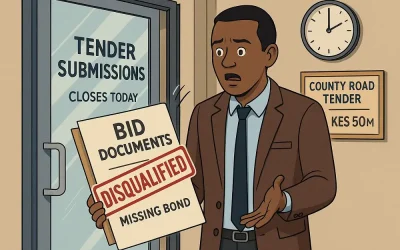

It is Thursday afternoon. The tender closes on Monday at 10am, your pricing is finally done (after you calculated it approximately 17 times), and then someone on the team reads the instructions to tenderers one more time: “Tender security in the form of a bid bond is required.” Panic. If you have ever lost a tender over a missing document rather than a bad price, this guide is for you. It covers every contract guarantee a Kenyan SME is likely to meet, from the bid bond at tender stage to the performance bond, advance payment guarantee and retention bond after award, and how to get each one without locking up the cash you need to actually deliver.
This is Discount Capital’s complete guide to bid bonds, performance bonds and contract guarantees in Kenya. If you already know what you need, our contract guarantees service page explains how we facilitate each instrument, and you can check whether your business qualifies in a few minutes.
What Is a Contract Guarantee?
A contract guarantee is a written promise, issued by a guarantor on behalf of a contractor or supplier, that the procuring entity (the “employer” or “beneficiary”) will be paid a stated amount if the contractor fails to meet a specific obligation. The contractor is the one who applies for it and is responsible for it. The employer simply holds it as security.
In plain terms: the employer does not know you yet. They are about to trust you with a tender process, a contract worth millions, or an advance payment. A guarantee tells them that if things go wrong on your side, they will not be left carrying the loss.
Every guarantee has four parties or elements you should be able to name before you apply:
- The applicant (principal): your business.
- The beneficiary: the ministry, county, state corporation, NGO or private company you are bidding for or working for.
- The guarantor: the institution that issues the instrument and stands behind it.
- The amount and validity: how much the beneficiary can claim and until when.
We wrote an earlier overview of contract guarantees in Kenya and a piece on why contract guarantees matter for Kenyan businesses today. This pillar goes further and puts all four instruments, the process, the costs and the common mistakes in one place.
The Four Contract Guarantees Kenyan SMEs Use Most
Think of a contract’s life in four stages: bid, win, mobilise and deliver, then hand over. Each stage has its own guarantee.
| Guarantee | Stage | What it protects | Usually ends when |
|---|---|---|---|
| Bid bond (tender security) | Tendering | That you will not withdraw your bid or refuse to sign if you win | The tender validity period ends, or a performance bond replaces it |
| Performance bond | After award | That you will deliver the contract as agreed | Completion, or the date set in the contract |
| Advance payment guarantee | Mobilisation | Any advance the employer pays you before work starts | The advance has been fully recovered from your payments |
| Retention bond | Handover | The money the employer would otherwise hold back for defects | The defects liability period ends |
1. Bid bond (tender security)
A bid bond is the security you submit with your tender. It assures the procuring entity that you are a serious bidder: you will keep your offer open for the tender validity period, and if you win, you will sign the contract and provide the performance security. If you withdraw or refuse to sign, the employer can claim on the bid bond.
The tender document sets the amount. In Kenyan public tenders it is usually stated either as a fixed shilling figure or as a small percentage of your tender price, so the “bid bond percentage” or “bid security percentage” you need is whatever that specific tender says. Read the instructions to tenderers and the tender data sheet carefully; they also specify the format (some insist on their own template), the validity period and who may issue it.
Some tenders, particularly those reserved under AGPO for youth, women and persons with disabilities, may ask for a signed tender securing declaration instead of a bid bond. Others still ask for a bid bond. Never assume: the tender document decides.
For a deeper look, read our guide to bid bonds in Kenya.
2. Performance bond
Once you win and sign the contract, the bid bond falls away and the employer asks for a performance bond (also called performance security). It guarantees that you will carry out the contract according to its terms. If you abandon the work, deliver badly or breach the contract, the employer can claim on the bond to cover the cost of fixing the problem or bringing in someone else.
What is a performance bond in construction? It is the employer’s safety net for the whole build. Road, water, energy, housing and ICT contracts almost always require one, and so do many large supply contracts. The amount and validity are set in the contract, and on our contract guarantees page performance bonds are valid for up to 24 months.
See our full guide to performance bonds in Kenya for more detail.
3. Advance payment guarantee
Many contracts allow the employer to pay part of the contract value upfront so you can mobilise: buy materials, move equipment to site and hire labour. Before releasing that money, the employer wants security that you will either use it on the project or pay it back. That security is an advance payment guarantee.
The useful thing about this guarantee is that it reduces as the advance is recovered. Each time the employer deducts part of the advance from your interim payments, your outstanding exposure falls. It is structured against your contract’s advance payment terms, so read those clauses before you apply.
4. Retention bond
Employers commonly hold back a portion of each payment as “retention” until the defects liability period ends, which can mean months of your own money sitting with the client after the job is finished. A retention bond replaces that cash. The employer releases the retention money to you, and holds the bond instead through the warranty or defects liability period.
For a contractor finishing a project and starting the next one, getting retention released early can be the difference between a smooth start and a cash crunch.
Bid Bond vs Performance Bond: The Difference in One Minute
This is one of the most searched questions on our site, so here is the short version:
- A bid bond secures your tender. It says, “This bidder is serious and will sign if they win.”
- A performance bond secures the contract. It says, “This contractor will deliver what they signed for.”
- Timing: the bid bond comes first and expires with the tender. The performance bond replaces it after award.
- Size: the performance bond is usually larger, because it covers delivery of the whole contract rather than just the tender process.
We break it down further in bid bonds vs performance bonds in Kenya.
Are Bid Bonds Refundable?
Strictly speaking, a bid bond is not a deposit, so there is nothing to “refund”. It is a guarantee document. If you lose the tender, or you win and provide your performance bond, the bid bond simply expires or is returned and discharged, and nobody claims on it. What you pay to obtain a guarantee is a fee for the service, not a refundable deposit.
Where cash has been placed as security (for example a security margin), that cash is released once the guarantee expires or is discharged. At DCL, releasing your security margin is part of the final “monitoring and closure” step.
The one case where a bid bond costs you real money is a claim: if you withdraw your bid during its validity period or refuse to sign after winning, the employer can call the bond, and you will have to repay the guarantor.
Who Needs Contract Guarantees in Kenya?
Any business that bids for or delivers contracts with a formal procuring entity will meet guarantees sooner or later. On our product page the main users are:
- SME contractors in construction, roads, water, energy, ICT and housing
- Suppliers of goods and services to government and corporates
- Professional service firms and consultants who need bid or performance bonds
- Growing businesses with strong contracts but limited access to traditional guarantee facilities
That last group is the one we hear from most. Their contracts are good and their buyers are good for it. What they lack is a long banking history, large fixed deposits or property to pledge, which is what traditional guarantee lines tend to require.
Why Cash Security Hurts Your Business
Some tenders accept cash or a banker’s cheque as tender security, and some contractors offer cash for performance security because it feels simpler. It rarely is.
Cash held as security cannot buy materials, pay casuals or fuel trucks. It sits with the employer until the guarantee period ends, sometimes for well over a year. Cash sitting somewhere doing absolutely nothing has basically chosen retirement, and on a contract you are trying to mobilise for, that is exactly when you need it working.
A guarantee lets you meet the employer’s requirement while keeping most of your cash free for the job. On DCL’s product, there is no need for full cash collateral: most guarantees require only a partial cash or security margin, with the remaining exposure covered through trade credit insurance. Your working capital stays where it belongs, on the project. Our article on SME cash flow management in Kenya explains why this timing matters so much.
How to Get a Bid Bond or Performance Bond: Step by Step
Here is how the process works with DCL, from first call to the day your security margin is released.
- Apply. Tell us about your tender or contract and the guarantee you need: the beneficiary, the amount, the validity period and the deadline.
- Verification. We assess your business and the underlying contract, and confirm your security margin and insurance cover.
- Structuring. DCL prices the guarantee transparently and issues a formal quote.
- Issuance. Once you accept, DCL processes and delivers your guarantee instrument to you.
- Monitoring and closure. We track your contract to completion and release your security margin once the guarantee expires or is discharged.
Throughout, DCL is your single point of contact, from the first application to the day the guarantee is discharged.
How long does it take?
Speed matters most at tender stage, when deadlines do not move. According to our product page, bid bonds are typically issued within 12 to 24 hours, and same-day where documents are complete. Performance bonds, advance payment guarantees and retention bonds typically take 48 to 96 hours, depending on how much due diligence the contract needs.
“Where documents are complete” is the important part. Haraka haraka haina baraka: the fastest way to get a guarantee is to start early with a complete file, not to call us two hours before the tender closes.
Bid Bond Requirements: Your Document Checklist
To apply for a guarantee through DCL you will need:
- Tender documents or the signed contract. For a bid bond, the tender notice and the section that sets the tender security amount, form and validity. For post-award guarantees, the signed contract or letter of award.
- The beneficiary’s required format, if the tender or contract provides its own guarantee template.
- Standard KYC documents for your business and its directors (registration documents, KRA PIN, IDs and similar).
- A Credit Reference Bureau (CRB) report.
Our team will guide you through the full checklist for your specific case. Preparing these early, ideally the day you decide to bid, removes most of the stress from the process. The same discipline applies across your finance applications, as we explain in why financial planning makes or breaks your next tender.
What Size of Contract Can Be Supported?
DCL’s contract guarantees are available for contracts with a ticket size of between KES 5,000,000 and KES 20,000,000. If your contract falls outside that range, talk to us anyway about the rest of your funding needs, such as LPO financing for the supply itself.
What Does a Bid Bond Cost in Kenya?
There is no single “bid bond price” in Kenya, and anyone quoting you one before looking at your tender is guessing. The cost of a guarantee depends on factors like these:
- The guarantee amount: a larger exposure costs more.
- The validity period: a bond that runs for 24 months costs more than one that runs for 90 days.
- The type of guarantee: a bid bond carries a different risk profile from a performance bond or advance payment guarantee.
- Your business and track record: your history of delivering similar contracts, your CRB report and your financial position.
- The beneficiary and the contract: who the employer is and how clear the contract terms are.
- The security margin: the share of the exposure covered by your own security.
At DCL, the guarantee is priced transparently at the structuring stage and you receive a formal quote before anything is issued. Build the cost of guarantees into your tender price from the start; it is a real cost of doing the contract, like transport or insurance.
Common Mistakes That Cost Kenyan Bidders the Tender
Most bid bond problems have nothing to do with money. They are paperwork errors that get a responsive bid declared non-responsive. Watch for these:
- Wrong amount. Even a small shortfall against the amount in the tender data sheet can disqualify you.
- Wrong validity. The bid bond must stay valid for the period the tender specifies, which is often longer than the tender validity itself.
- Wrong beneficiary name or tender number.
- Wrong format. If the tender provides a template, use it word for word.
- Unacceptable issuer. Some tenders specify which types of institution may issue the security. Check before you apply.
- Starting too late. A guarantee needs verification and structuring. A complete file submitted early is the best protection against a missed deadline.
- Forgetting the next bond. When you win, the performance bond is often due within a short window after notification. Plan for it while you are still bidding.
Red Flags When Choosing a Guarantee Provider
A contract guarantee is only useful if the employer accepts it and it holds up. Be wary of:
- Anyone who promises approval before looking at your documents or contract.
- Providers who will not give a formal written quote before issuance.
- Guarantees that do not follow the beneficiary’s required format.
- Offers that skip KYC or due diligence altogether. If it is too easy, the employer may not accept the paper.
- No clear answer on how and when your security margin will be released.
What to look for instead: a provider who reads your tender properly, prices transparently, tells you exactly what is needed, and stays with you from application to closure. That is the relationship DCL aims to give every client, and you can read more about Discount Capital and how we work with SMEs.
A Practical Timeline: From Tender Notice to Handover
Here is how guarantees fit into a typical contract, so nothing catches you off guard:
- Tender advertised. Read the tender security requirements on day one. Note the amount, format, validity and deadline. Gather your KYC documents and CRB report.
- A week or more before closing. Apply for the bid bond with the tender documents attached. Review the draft guarantee against the tender wording.
- Tender submission. Submit the bid bond with your bid exactly as instructed.
- Notification of award. Check the deadline for performance security in the award letter or contract. Apply immediately for the performance bond, and for an advance payment guarantee if the contract offers an advance.
- Contract signed and mobilisation. The performance bond replaces the bid bond. The advance payment guarantee unlocks the upfront funds.
- Delivery. The advance payment guarantee reduces as the advance is recovered from your payments. Track your bond expiry dates and arrange renewals early if the project runs long.
- Completion and handover. Convert held retention into a retention bond so the cash is released. At closure, your security margin is released once each guarantee expires or is discharged.
How Guarantees Work With Your Other Funding
A guarantee gets you through the door. It does not pay for the job. Most contractors and suppliers need two or three tools working together across the contract:
- Guarantees to bid, sign and mobilise without locking up cash.
- LPO financing to buy the goods or materials for a confirmed order. Our LPO financing in Kenya guide explains how it works, and you can see the product on our LPO financing page. If you are new to the term, start with what an LPO means in business.
- Invoice discounting to unlock cash from invoices while you wait 60, 90 or more days for the employer to pay. See our invoice discounting guide and the invoice discounting product page.
Planned together, these tools cover the full cycle: bid, win, mobilise, deliver and get paid. It is rarely a cash problem. It is a timing problem.
Your 7-Day Plan Before the Next Tender Closes
- Day 1: Read the tender security, performance security and advance payment clauses. Write down every amount, format and deadline.
- Day 2: Pull together your company and director KYC documents and request your CRB report.
- Day 3: Check your qualification with DCL and send us the tender details.
- Day 4: Review the formal quote and add the guarantee costs to your tender price.
- Day 5: Accept, and check the draft wording against the tender: amount, validity, beneficiary and tender number.
- Day 6: Receive the bid bond and file it with your bid.
- Day 7: Plan for the performance bond and mobilisation funding, so that if you win, you can sign and start without a scramble.
Frequently Asked Questions About Bid Bonds and Performance Bonds in Kenya
What percentage is a bid bond in Kenya?
It depends on the tender. Each tender document states the tender security required, either as a fixed shilling amount or as a percentage of the tender price. Always use the figure in the tender data sheet for that specific tender.
Do I need to put up 100% cash security?
No. With DCL, most guarantees require only a partial cash or security margin, with the remaining exposure covered through trade credit insurance, so your working capital stays free for the project.
How fast can a bid bond be issued?
Bid bonds are typically issued within 12 to 24 hours, and same-day where documents are complete. Performance bonds, advance payment guarantees and retention bonds typically take 48 to 96 hours, depending on the due diligence required.
What happens to my bid bond if I lose the tender?
Nothing is claimed. The bid bond expires at the end of its validity or is returned and discharged, and any security margin is released at closure.
Can a performance bond replace the bid bond?
Yes, that is the normal sequence. Once you win and sign, the employer releases the bid bond and holds the performance bond for the life of the contract.
Win the Tender. Bond the Contract. Keep Your Cash Working.
A bid bond or performance bond should never be the reason you miss a contract you priced well and can deliver. Start early, read the tender carefully, keep your documents ready, and let your cash do the work it is meant to do.
Discount Capital facilitates bid bonds, performance bonds, advance payment guarantees and retention bonds for qualifying businesses. Visit our contract guarantees page, check your qualification, or contact our team to talk through your next tender.
📞 +254 713 383 855 | +254 711 093 106
📧 info@discountcapital.co.ke
📍 IKM Place, 4th Floor, 5th Ngong Avenue, Nairobi
All guarantees are subject to assessment, documentation, approval and applicable terms.