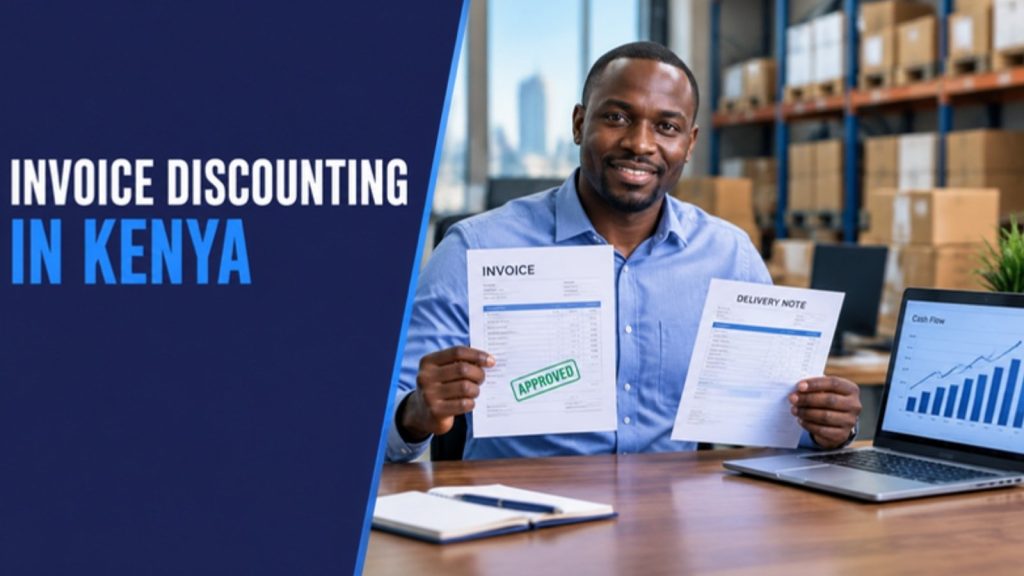
You delivered the goods. The client signed the delivery note. The invoice is approved. And now you wait 60, 90, sometimes 120 days to be paid, while salaries, rent, suppliers and the next order all need money this week. For thousands of Kenyan SMEs, the problem is not that they aren’t profitable. It’s that their money is sitting in someone else’s accounts payable. Invoice discounting exists to solve exactly that.
This guide explains how invoice discounting works in Kenya, step by step: what it is, how it differs from factoring and bill discounting, who qualifies, what documents you need, what it costs and how to judge that cost, the mistakes to avoid, and how to use it without letting it control your business.
What Is Invoice Discounting?
Invoice discounting is a way of turning unpaid invoices into cash before your customer pays. A financier advances you funds against an approved invoice owed to you by a creditworthy buyer, sometimes called the procuring entity. When the buyer pays the invoice, the advance is settled and the financier’s charges are deducted.
In plain terms: you are not borrowing against your house or your car. You are borrowing against money that is already owed to you. That is why invoice discounting often works for businesses that a bank has turned down. The quality of your buyer matters as much as your own balance sheet, a point we explored in your bank said no, but your buyer is creditworthy.
Invoice discounting meaning, in one example
A Nairobi supplier delivers office furniture to a corporate client and raises an invoice for KES 1,200,000, payable in 90 days. Rather than wait three months, the supplier applies to discount the invoice. Once approved, the financier advances an agreed portion of the invoice value. The supplier uses the cash to pay its own suppliers and take on a second order. When the client pays at day 90, the facility is cleared, and the supplier keeps the balance after charges.
How Invoice Discounting Works in Kenya: Step by Step
- You deliver and invoice. You supply goods or services to your customer and raise an invoice on agreed credit terms.
- The buyer acknowledges the invoice. A financier wants confidence that the invoice is genuine and will be paid. This often means a confirmed delivery, an approved invoice, and a letter of undertaking or assignment from the procuring entity.
- You apply for financing, sharing the invoice, supporting documents and your business information.
- The financier assesses the deal. They look at you (your track record and bank conduct) and, crucially, at the buyer’s ability and history of paying.
- Funds are released once the application is approved and the documentation is in place.
- The buyer pays on the due date, usually into an account or arrangement agreed in the documentation.
- The facility is settled. The advance and charges are cleared, and any balance due to you is released.
At Discount Capital, the process starts with an online qualification check that takes under three minutes. A representative then meets you to review your documents, and funds are deposited once the application is reviewed and approved.
Invoice Discounting vs Factoring vs Bill Discounting
These terms are often used interchangeably in Kenya, but they are not quite the same.
Invoice discounting
You borrow against your invoices, but you generally remain in charge of your customer relationship and collections. The financing is usually tied to specific approved invoices or a limit you draw against.
Factoring
In factoring, the financier typically buys the invoices and often takes over collection from the buyer. The customer knows a third party is involved and may pay the factor directly. Factoring can suit businesses that want to outsource credit control, but it is a deeper change to how you deal with customers.
Bill discounting
Bill discounting usually refers to discounting a bill of exchange: a formal written instrument, often accepted by the buyer or used in trade under letters of credit. It is closely related, but more formal and common in trade finance. We compared the two in detail in bill discounting vs invoice discounting in Kenya.
Cheque discounting
If your buyer pays with post-dated cheques, cheque discounting lets you access the funds before the cheque date. It follows the same logic of bringing forward money that is already owed. See our guide to the cheque discounting facility in Kenya.
Invoice discounting vs LPO financing
The difference is timing. LPO financing in Kenya funds you before delivery, so you can buy the goods to fulfil an order. Invoice discounting funds you after delivery, while you wait to be paid. Many suppliers use both on the same contract: LPO financing to deliver, then invoice discounting to bridge the payment period.
Who Is Invoice Discounting For?
Invoice discounting suits businesses that sell on credit to reliable buyers and are held back by long payment cycles. In Kenya that commonly includes:
- suppliers to large corporates, manufacturers and retailers
- contractors and suppliers to government entities and counties
- suppliers to NGOs and development projects
- distributors and wholesalers with steady trade customers
- service firms such as cleaning, security, logistics, IT and facilities management with monthly invoices
It is less suitable if your customers are mostly individuals, your invoices are often disputed, or your buyers have a poor payment history. In those cases the problem is the receivable itself, and no financier can fix that.
Invoice Discounting for Government, County and Corporate Suppliers
Some of the longest payment cycles in Kenya come from the buyers suppliers most want to win: government ministries, state agencies, counties and large corporates. Their invoices are usually good. They simply pass through several approval stages before payment, and each stage adds days.
If you supply these buyers, a few habits make invoice discounting smoother:
- Match every document to the order. The LPO or contract, the delivery note, the inspection or acceptance certificate and the invoice should all agree on quantities, prices and references. A mismatch is the most common reason an invoice sits unapproved.
- Track where your invoice is in the approval chain. Know who must sign off, and follow up politely at each stage. An invoice that is “in process” is not yet an approved receivable.
- Know the buyer’s payment pattern. If a client historically pays at 100 days rather than 60, plan your facility around reality, not the contract terms.
- Prepare your buyer for the undertaking letter. Procurement and finance teams at large entities have their own procedures for letters of undertaking or assignment. Ask early what they need from you.
The Full Cash Cycle: From LPO to Payment
It helps to see where invoice discounting sits in the life of a typical supply contract:
- You win the order. The buyer issues an LPO or contract.
- You need cash to deliver. If you must buy stock or materials first, this is where LPO financing comes in.
- You deliver and invoice. The buyer inspects, accepts and approves your invoice.
- You wait for payment. This is the gap invoice discounting fills, so you can pay suppliers and staff and take on the next order.
- The buyer pays. The facility is settled and the cycle can start again.
Businesses that plan the whole cycle, rather than reacting when cash runs out, get far more value from financing. They know in advance which orders will need funding, at which stage, and for how long. We first introduced the product in invoice discounting in Kenya and described how the facility is structured in the invoice discounting facility in Kenya. This guide brings both together with the practical detail you need to apply.
Who Qualifies at Discount Capital?
Every financier sets its own criteria. At Discount Capital, the published eligibility criteria for invoice discounting are:
- at least one year in business
- individuals aged at least 21
- at least six months banking with your current bankers
- no more than three unpaid items in the last six months
- no more than two excess drawings in the last six months
- regular, consistent account credits over the last 12 months, with no declining trend
- not on the prohibited list in the credit policy
- Kenyan nationality
- acceptance of the security arrangements and documentation
Notice how much of this is about bank conduct. Bounced cheques, frequent overdrawn balances and erratic deposits make any financier nervous, because they suggest cash flow is already under strain. Cleaning these up is one of the most useful things you can do before you apply.
How Much Can You Discount, and for How Long?
At Discount Capital, invoice discounting limits range from KES 100,000 to KES 7,000,000, with any single invoice not exceeding 25% of the limit. Higher or lower limits may be considered, subject to policy approval. The repayment period is up to 90 days.
The 25% rule is worth understanding. It spreads risk across several invoices, so the facility isn’t hanging on one payment. If most of your business comes from a single large invoice at a time, discuss this at the start so the structure fits how you actually trade.
How long does a limit last?
Limits are reviewed over time:
- New customer, new or existing procuring entity: the limit is available for six months, renewed for a further six months, then renewed annually with fresh bank statements.
- Existing customer, new or existing procuring entity: the limit is available for 12 months, then renewed annually with fresh bank statements.
In other words, a good track record earns you longer, simpler renewals.
Invoice Discounting Requirements: Your Document Checklist
Having your documents ready is the single biggest factor in how quickly an application moves. For Discount Capital’s invoice discounting, you will need:
Application documents
- a completed application form
- copy of national ID or passport
- MemArts or CR1 and CR2 copies
- certificate of incorporation
- bank or M-Pesa statements for the last six months
- company and directors’ KRA PIN certificates
- trading licence, or an electricity or water bill
- two passport-size photos
- company profile, if available
- management accounts, if available
Collateral and facility documents
- a letter of undertaking or assignment from the procuring entity
- the letter of offer
- standard DCL documents
- securities as set out in the credit policy
- limit maintenance terms
The letter of undertaking or assignment from your buyer is often the step that takes longest, because it depends on someone else’s finance or procurement team. Raise it early, and explain to your buyer that it does not change what they owe or when, only where the payment goes.
What Does Invoice Discounting Cost?
Charges vary by financier, by the size and tenor of the facility, and by the risk profile of you and your buyer. Instead of focusing only on the headline rate, work out the total cost against the benefit:
- What does waiting cost you? Missed supplier discounts, late payment penalties, lost orders you couldn’t fund, or an expensive overdraft.
- What will you do with the cash? If the advance lets you fulfil another profitable order, the facility pays for itself many times over. If it only covers a hole that keeps reopening, look harder at your cash flow.
- What is the all-in cost? Ask for every charge in writing, including any arrangement, processing or documentation fees, and calculate the cost for the actual number of days you expect to use the money.
- How fast is it? Cheap money that arrives after the opportunity has passed isn’t cheap.
A simple rule: invoice discounting makes most sense when the margin on what you do with the cash is clearly higher than the cost of the facility. It also helps to compare like with like. A facility you use for 30 days on one invoice costs very differently from one you draw on continuously all year, so model the cost on how you will actually use it.
The Benefits of Invoice Discounting
- Cash flow that matches your growth. As your invoices grow, so does the funding available against them.
- No need to wait on slow payers. You can pay staff and suppliers on time, which protects your reputation. Late payments ripple down supply chains, as we explained in late supplier payments in Kenya.
- Funding based on your buyer’s strength. Useful for young businesses with strong clients.
- Short-term by design. The facility is repaid when the invoice is paid, so you don’t carry long-term debt for a short-term gap.
- Takes on bigger contracts. You can accept larger orders without fearing the 90-day wait.
The Risks and Common Mistakes
- Discounting disputed invoices. If the buyer questions quantities or quality, payment stalls. Only discount invoices that are approved and undisputed.
- Weak paperwork. Missing delivery notes, unsigned documents or invoices that don’t match the LPO cause delays and rejections.
- Relying on one buyer. If one customer accounts for most of your invoices, any delay on their side hits you hard.
- Using it to cover losses. Invoice discounting fixes timing problems, not profitability problems. If the business is losing money, more funding only delays the reckoning. Watch for the financial red flags that signal trouble.
- Poor bank conduct. Bounced cheques and repeated excess drawings can disqualify you before your invoice is even considered.
- Not reading the documentation. Understand what happens if the buyer pays late, what security you provide, and how settlement works.
How to Choose an Invoice Discounting Provider in Kenya
Ask any provider these questions before you sign:
- What is your minimum and maximum limit, and is there a per-invoice cap?
- What is the maximum tenor, and what happens if my buyer pays late?
- What exactly do you need from my buyer: a letter of undertaking, an assignment, or confirmation only?
- What are all the charges, in writing, for a typical deal of my size?
- How long does approval take once documents are complete, and how are funds released?
- How is the limit renewed, and what do you need at renewal?
- Can you also fund my orders before delivery (LPO financing) or my post-dated cheques, so one relationship covers the whole cycle?
- Are you a registered, established local business with a physical office I can visit?
A good provider will answer every question plainly and won’t rush you to sign.
A Practical Plan to Use Invoice Discounting Well
Before you apply
- List your current unpaid invoices by buyer, amount and due date.
- Identify which buyers are reliable payers with a track record.
- Collect six months of bank or M-Pesa statements and check for unpaid items or excess drawings.
- Gather your company documents and PIN certificates.
When you apply
- Complete the online qualification check.
- Talk to your buyer early about the letter of undertaking or assignment.
- Agree a limit that fits your typical invoice sizes and the 25% per-invoice rule.
Once you’re running
- Discount only approved, undisputed invoices.
- Track every discounted invoice against its due date.
- Keep your bank conduct clean, since it affects renewals.
- Review the facility every quarter: is it funding growth, or just covering gaps?
Invoice discounting works best as one part of a wider cash flow plan, alongside the habits we set out in SME cash flow management in Kenya and from invoice to income: avoiding cash flow bottlenecks.
Frequently Asked Questions About Invoice Discounting
Is invoice discounting a loan?
It is a form of short-term financing secured against your invoices rather than a traditional term loan. You receive funds against money already owed to you, and the facility is settled when your buyer pays.
Do I need collateral for invoice discounting?
The invoice and the buyer’s undertaking or assignment are central to the security, and the financier’s standard documentation and credit policy will set out any other securities. Requirements vary by deal, so confirm them at the start.
Can a startup use invoice discounting?
Discount Capital requires at least one year in business for invoice discounting. Younger businesses may want to look at our guide to small business loans for startups in Kenya in the meantime.
How long does invoice discounting take?
The qualification check takes minutes. After that, timing depends mostly on how complete your documents are and how quickly your buyer provides its letter of undertaking or assignment.
What is the difference between invoice financing and invoice discounting?
“Invoice financing” is the umbrella term for funding against invoices. Invoice discounting is one type of it, where you typically keep control of your customer relationship, while factoring is another type, where the financier often handles collection.
Turn Your Invoices Into Working Capital
If unpaid invoices are holding your business back, invoice discounting can turn them into the cash you need to pay suppliers, meet payroll and take on the next contract. Discount Capital’s invoice discounting facility offers limits from KES 100,000 to KES 7,000,000 with repayment periods of up to 90 days. It sits alongside our wider receivable-based financing options.
Start with our quick online qualification check, or talk to us directly:
📞 +254 713 383 855 | +254 711 093 106
📧 info@discountcapital.co.ke
📍 IKM Place, 5th Ngong Avenue, 4th Floor, Nairobi
Or contact Discount Capital about invoice discounting.